


Musical Intervention in Parkinson's Disease Treatment
Authored by: Hayoon Kim
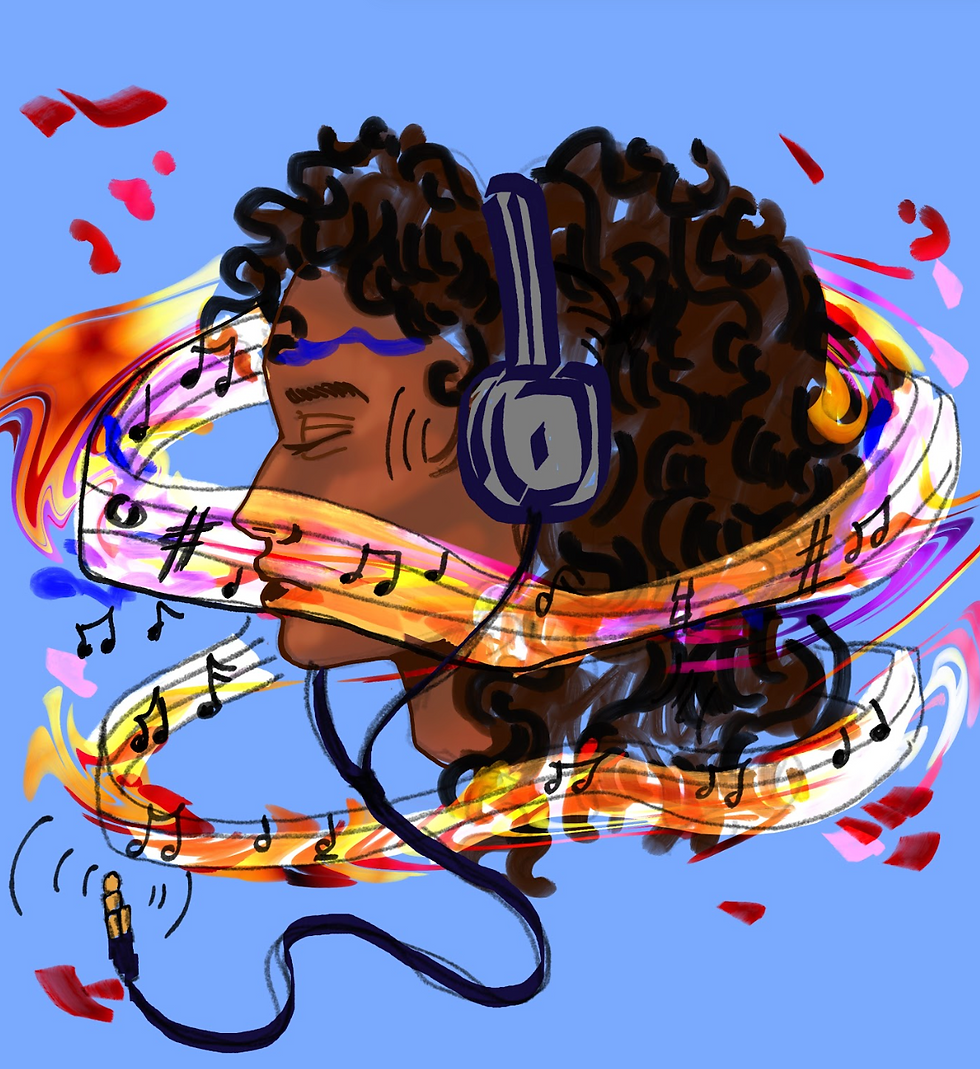
Art by: Ava Shi
Parkinson's disease (PD) is a neurodegenerative disorder that disrupts the motor system, causing symptoms such as slowness of movement, muscular rigidity, and tremor [1]. These motor impairments significantly affect daily life. The disease is primarily associated with the degeneration of dopamine-producing neurons in the basal ganglia, a midbrain structure that regulates voluntary movement, and more specifically, the substantia nigra [1]. Dopamine is essential for smooth, coordinated muscle activity, and its absence disrupts communication within motor circuits. As dopamine levels decline, patients experience difficulties initiating and controlling movements.
Although pharmacological treatments such as Levodopa remain central to the treatment, complementary approaches have gained attention for their ability to alleviate the symptoms. Among these, musical intervention has emerged as a helpful approach. Music engages widespread neural networks, including motor, cognitive, and emotional systems, making it uniquely suited to address the challenges of Parkinson’s disease.
One of the most widely studied forms of musical intervention in Parkinson’s treatment is rhythmic auditory stimulation (RAS). This technique uses external rhythmic cues, often in the form of metronome beats or rhythmically structured music, to help improve gait, or how a person walks. Individuals with Parkinson’s disease often experience shuffling steps, reduced arm swing, and freezing while walking. RAS helps patients align their movements to a steady beat, improving their stride length and speed. This improvement happens because the brain’s motor system responds to rhythmic cues by stimulating alternative neural pathways that are used in place of impaired basal ganglia timing mechanisms [2]. Research has demonstrated that this mechanism works since significant improvements in walking velocity and stride length resulted from rhythmic cueing interventions [3]. Other studies have also shown that RAS significantly accelerates patients’ speed [4]. Music, therefore, acts as an external timing system that supports smoother and more consistent movement.
Another intervention includes clinical programs targeting PD patients. The Parkinson’s Foundation and the American Music Therapy Association created music programs like singing and dancing to support patients [5]. These activities are both recreational and therapeutic, and target patients’ specific symptoms to improve their bodily functions. Singing, for example, can significantly improve vocal strength and respiratory control. PD patients develop hypophonia, a weak voice, due to reduced muscle control [6]. For this reason, group singing sessions that help participants practice breath support and articulation in a supportive environment help alleviate the symptoms. An example of this therapy is Singing with Parkinson’s, a therapeutic choir for patients with PD [7]. This program was made to improve the oral muscle movements while providing engaging activities, leading to an effective complement to the treatment.
Beyond motor and speech benefits, music therapy also addresses the psychological and emotional dimensions of Parkinson’s disease. Research has shown that active music therapy not only improves motor functions, but also the emotional well-being when compared to standard rehabilitation approaches [8]. One of PD’s major emotional influences is depression and anxiety, which is often exacerbated by social isolation [9]. Thus, musical activities improve the symptoms by encouraging social involvement and connection. Additionally, the act of engaging with music, like learning an instrument, can activate reward circuits in the brain, enhancing dopamine release and mood regulation [10]. By experiencing accomplishments through musical activities, PD patients can have improved emotional regulation and experience decreased depression.
Overall, musical intervention represents an evidence-based and human-centered approach to Parkinson’s disease treatment. By using music therapy’s influence on emotion and motor function, PD patients can have improvements in speech, mood, and social engagement. As research continues to evolve, music is increasingly recognized not simply as art, but as a therapeutic modality capable of transforming the lived experience of individuals with PD.
References:
National Institute of Neurological Disorders and Stroke. (n.d.). Parkinson’s disease. U.S. Department of Health and Human Services.Retrieved from https://www.ninds.nih.gov/health-information/disorders/parkinsons-disease
Nombela, C., Hughes, L. E., Owen, A. M., & Grahn, J. A. (2013). Into the groove: Can rhythm influence Parkinson’s disease? Neuroscience & Biobehavioral Reviews, 37(10), 2564–2570. https://doi.org/10.1016/j.neubiorev.2013.08.003
Thaut, M. H., McIntosh, G. C., & Rice, R. R. (1996). Rhythmic auditory stimulation in gait training for Parkinson’s disease patients. Movement Disorders, 11(2), 193–200. https://doi.org/10.1002/mds.870110213
Ye, X., Li, L., He, R., Jia, Y., & Poon, W. (2022). Rhythmic auditory stimulation promotes gait recovery in Parkinson’s patients: A systematic review and meta-analysis. Frontiers in Neurology, 13, 940419. https://doi.org/10.3389/fneur.2022.940419
Parkinson’s Foundation. (2018, August 14). Feel the rhythm: Music therapy and Parkinson’s disease. Parkinson’s Foundation. Retrieved from https://www.parkinson.org/living-with-parkinsons/stories/singing-with-parkinsons#:~:text=The%20choir%20continues%20to%20build
Arnold, C., Gehrig, J., Gispert, S., Seifried, C., & Kell, C. A. (2013). Pathomechanisms and compensatory efforts related to Parkinsonian speech. NeuroImage: Clinical, 4, 82–97. https://doi.org/10.1016/j.nicl.2013.10.016
Parkinson’s Foundation. (n.d.). Singing with Parkinson’s. Parkinson’s Foundation. Retrieved from https://www.parkinson.org/living-with-parkinsons/stories/singing-with-parkinsons
Pacchetti, C., Mancini, F., Aglieri, R., Fundarò, C., Martignoni, E., & Nappi, G. (2000). Active music therapy in Parkinson’s disease: An integrative method for motor and emotional rehabilitation. Psychosomatic Medicine, 62(3), 386–393. https://doi.org/10.1097/00006842-200005000-00012
Kalia, L. V., & Lang, A. E. (2015). Parkinson’s disease. The Lancet Neurology, 14(8), 896–912. https://doi.org/10.1016/S1474-4422(15)00118-0
Altenmüller, E., & Schlaug, G. (2015). Apollo’s gift: New aspects of neurologic music therapy. Progress in Brain Research, 217, 237–252. https://doi.org/10.1016/bs.pbr.2014.11.029


I recently came across some fascinating insights on user engagement techniques that really resonated with me. In particular, the focus on actionable strategies for improving reader retention was spot on. If you're looking for more in-depth analysis, I found the data on audience behavior at https://blogyz.xyz/ to be incredibly enlightening. What specific strategies have you all found most effective in keeping your readers coming back?