


The Limits of Human Compassion
Authored by: Evan Wong
Art by: Laura Lee
Humans are widely considered to be the most moral, ethical creatures on Earth, yet so many of our actions seem to directly contradict this generalization. One of the most prevalent examples of this contradiction is our tendency to cry over the deaths of fictional characters while turning a blind eye towards real-world humanitarian crises. A vast majority of people agree that real-world tragedies bear much greater weight, but this rational thinking seems to take a backseat in practice. What are the specific neural mechanisms that cause this clash between our rational and moral decision-making?
In order to understand why fiction is able to pull at our heartstrings so easily, we must first examine the role of fiction in our everyday lives. According to psychologist Keith Oatley from the Greater Good Magazine, fiction allows us to identify empathetically with characters by mentally casting ourselves alongside them, viewing the world from their perspective, and even experiencing their emotions. Readers’ awareness that fiction is not real creates a wall between them and the story, establishing a safe space to practice real-world empathy without the pressures, demands, or self-interest of real-world interactions [1]. This evidence is supported by Anna Abraham’s 2008 study on brain activation after receiving real vs. fictional information. Through fMRI scans, Abraham determined that the anterior medial prefrontal cortex (amPFC) and posterior cingulate cortex (PCC) automatically "tag" information based on its reality. These regions show more activation for real-world information than for fictional ones [2]. In fiction, we maintain a level of emotional control, dictating how invested we become with no fear of potential consequences. It is precisely this process of maintaining control that allows us to delve freely into the story and its characters in ways that we do not allow ourselves to in everyday life.
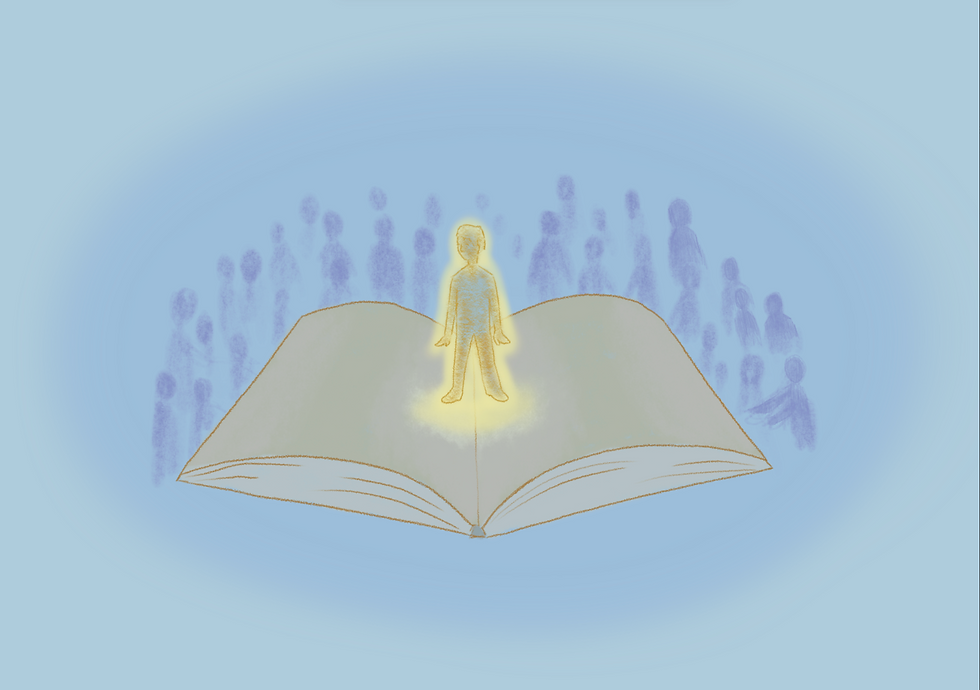
In contrast, real-world tragedies often evoke a sense of helplessness, which triggers the brain to subconsciously limit empathetic emotions as a defense mechanism. This behavior is encapsulated by the psychological concept of the Identifiable Victim Effect, during which the emphasis on a single individual or scenario causes it to be more emotionally painful. As Soviet dictator Josef Stalin famously articulated: “The death of one man is a tragedy; The death of millions is a statistic.” Despite our rational minds prioritizing the wellbeing of the masses over individuals, our morality only shines through when a strong emotional pull exists to identifiable victims [3]. When news channels present graphs and statistics of escalating wars, we do not feel much sympathy until we see images of endangered families; when humanitarian organizations ask for donations, most of us walk away thinking our contributions would be a mere drop in the bucket, yet feel compelled to help when we hear the story of a young child who is affected.
This subconscious behavior is highly prevalent in everyday life, and is also thoroughly researched in academia. Recent neuroscience findings reveal that the medial prefrontal cortex (mPFC), a brain region essential for perspective-taking and empathy, shows significantly greater activation for stories about a single victim compared to those about mass suffering [4]. This "psychic numbing" effect, as coined by researchers, begins as early as introducing a second victim in a scenario, suggesting that our capacity to understand and empathize with others is naturally limited. Thus, there are two processes simultaneously at play: an emotional pull towards identifiable individuals and a suppression of empathetic emotion for large groups of sufferers.
The phenomenon becomes particularly relevant in our current media landscape, where we are bombarded with overwhelming amounts of tragic information through news outlets and social media. This influx of information leads to empathy fatigue, a defense mechanism where our brains shut down compassion to protect us from emotional exhaustion [5]. To fight against our automatic neurological response to focus on individuals, reporters and humanitarian organizations must emphasize personal, human-driven narratives over attention-grabbing statistics. In doing so, they can take advantage of our brain’s natural affinity towards human-centered compassion, ensuring that the weight of large crises remains visible to our moral conscience.
References:
Oatley, K. (2005, September 1). A feeling for fiction. Greater Good Magazine. https://greatergood.berkeley.edu/article/item/a_feeling_for_fiction
Abraham, A., von Cramon, D. Y., & Schubotz, R. I. (2008, June 1). Meeting George Bush versus Meeting Cinderella: The neural response when telling apart what is real from what is fictional in the context of our reality. Journal of Cognitive Neuroscience, 20(6), 965-976. https://doi.org/10.1162/jocn.2008.20059
Brzosko, M. (2023, October 31). Why hearing about mass tragedies decreases empathy. Medium. https://medium.com/civlead/big-numbers-make-you-emotionally-numb-ae6ea6d3f781
Ye, Z., Heldmann, M., Slovic, P., & Münte, T. F. (2020, June 9). Brain imaging evidence for why we are numbed by numbers. Scientific Reports, 10(1), Article 9270. https://doi.org/10.1038/s41598-020-66234-z
Albers, S. (2021, June 25). Empathy fatigue: How stress and trauma can take a toll on you. Cleveland Clinic Health Essentials. https://health.clevelandclinic.org/empathy-fatigue-how-stress-and-trauma-can-take-a-toll-on-you


I recently came across some fascinating insights on user engagement techniques that really resonated with me. In particular, the focus on actionable strategies for improving reader retention was spot on. If you're looking for more in-depth analysis, I found the data on audience behavior at https://blogyz.xyz/ to be incredibly enlightening. What specific strategies have you all found most effective in keeping your readers coming back?